


Learn why toroidal transformers are well suited for medical equipment, how they provide electrical isolation, and what makes their design different from conventional EI transformers.
Toroidal transformers are ideal for electrical isolation in medical equipment because they are compact, can be completely encapsulated when necessary, and have low stray fields, making them less likely to cause electromagnetic disturbances.
Isolation means physically and electrically separating two parts of a circuit that may interact. The isolation is achieved by using electromagnetic field coupling between the two circuits. For an isolation method to be safe enough to use in medical equipment, it needs to have two things: high-integrity isolation components and a safe insulator barrier. For example, an insulator can be a piece of plastic, a keep-out space in a PWB, or an air gap. The three most commonly used isolation methods are optocouplers (light), transformers (magnetic flux), and capacitive couplers (electric field).
Isolation provides several safety advantages in medical equipment:
- Breaks ground loops
- Improves common-mode voltage rejection
- Allows the two parts of a circuit to operate at different voltage levels, meaning one side can remain at a safe voltage while the other is at a hazardous voltage level
For the purposes of this discussion, we will focus on using transformers as a method of electrically isolating medical equipment.
Transformer Overview
A transformer is an electrical device that transfers energy between two or more circuits through electromagnetic induction. Commonly, transformers are used to increase or decrease the voltages of alternating current in electric power applications. This is accomplished by passing a varying current through the primary winding to generate a magnetic flux in the transformer’s core. This flux then induces a voltage in the transformer’s secondary winding. Depending on the ratio of the primary windings to the secondary windings, the transformer’s output voltage can be increased or decreased.
For most transformers designed for use within homes or offices, one of two styles of transformers is used: EI laminate core or toroidal core.
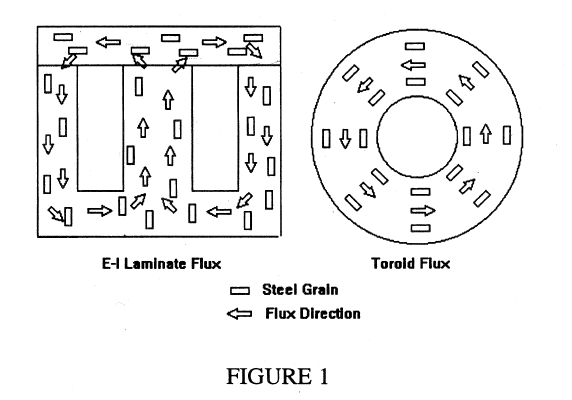
E-I transformer construction
In an E-I structure, the matching “E” and “I” components are stamped from sheets of thin grain-oriented electrical steel that are later stacked to create the core. The primary and secondary windings are wound on bobbins. Multiple bobbins are placed on spindles and spun in order to apply the windings. This method of using bobbins allows for automation that reduces the manufacturing times and also provides insulation between the windings and the core. The EI core laminations are stacked inside the bobbins to complete the transformer.
Toroidal transformer construction
A toroidal core is made from a continuous strip of silicon steel, which is wound like a tight clock spring. The ends are tacked into place with small spot welds, to prevent the coiled steel from unwinding. The core is insulated with an epoxy coating or a set of caps or multiple wraps of insulating film (such as Mylar or Nomex). The transformer’s windings are applied directly onto the core itself. Additional insulation is required to isolate the windings.Since the windings must be wound through the center hole of the core and the core is one piece, bobbins can’t be used on toroidal transformers. This makes manufacturing toroidal transformers more labor-intensive.
If toroidal transformers are more labour-intensive to manufacture and less suited to automation, why are they used? The answer lies in their performance. The continuous steel core allows toroidal transformers to be compact and lightweight, with high efficiency, low stray magnetic fields and low noise levels compared with many conventional EI transformers. These characteristics make them well suited to medical electrical equipment and other applications where space, efficiency and low electromagnetic interference are important.
UL 60601-1 certified transformers for medical standards
Safety is a key consideration when designing transformers for medical applications. Our medical-grade toroidal transformers are designed to meet the requirements of IEC 60601-1, supporting the safety and reliability demanded by medical electrical equipment.