


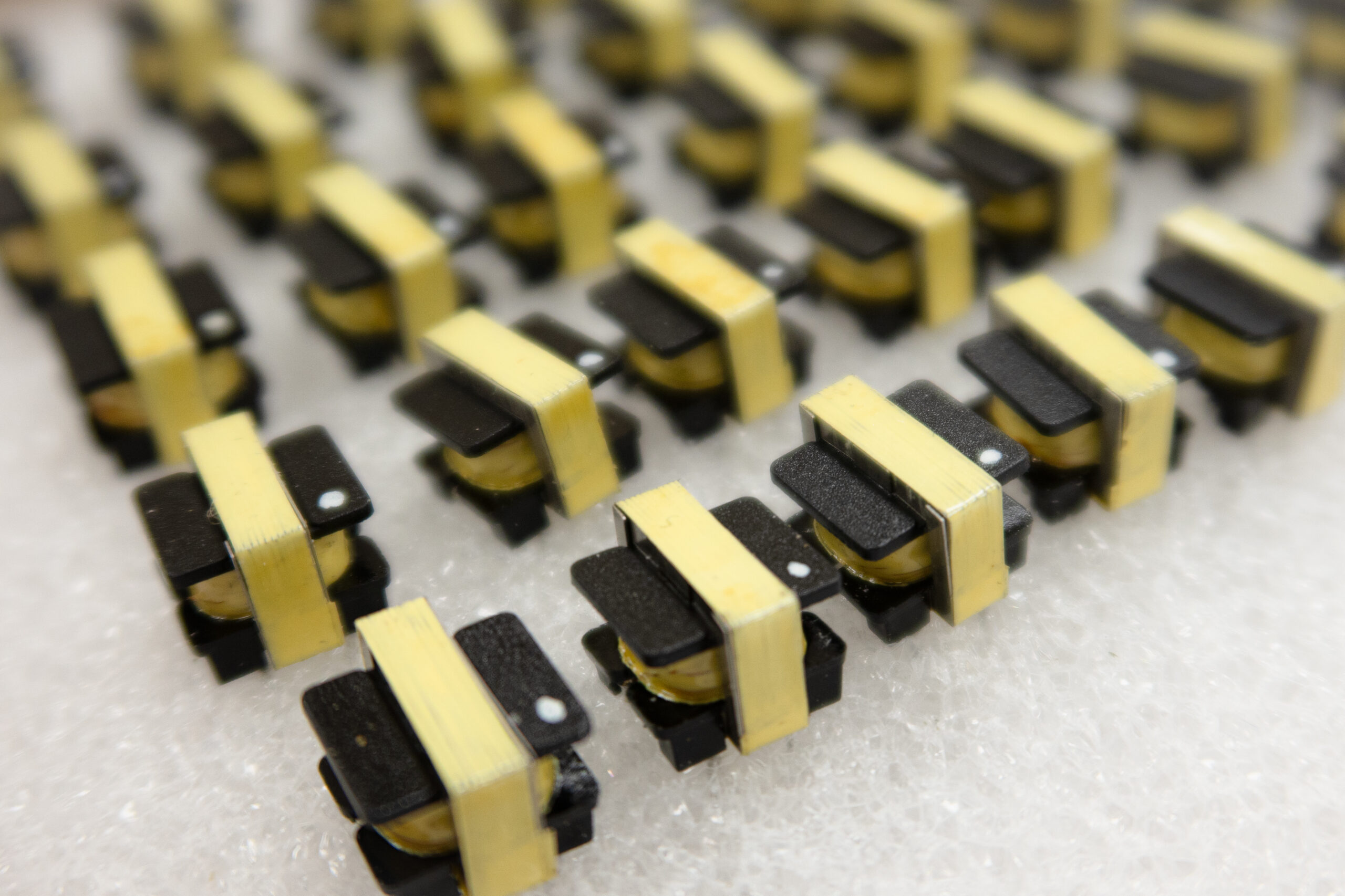
Built with advanced ferrite cores and optimized winding structures, they enable high efficiency, low core losses, and excellent performance at elevated switching frequencies. Compact and lightweight, these transformers are ideal for applications such as power converters, inverters, and electronic devices, delivering high power density, improved thermal management, and reliable performance in demanding high-frequency environments. Unlike traditional transformers that run at 50/60 Hz, these operate at much higher frequencies (typically tens of kHz up to MHz), using fast electronic switching.
How a high-frequency switch-mode transformer works in a system
In an SMPS, the mains AC is converted into DC, with the high-speed switching
electronic switches rapidly turn the DC on and off at high frequency, this pulsed current flows through the transformer’s primary coil, creating a rapidly changing magnetic field, voltage is induced in the secondary coil and then with output rectification and filtering, the output is converted back to smooth DC for use by devices.
Typical Applications for High frequency switch-mode transformers
Consumer electronics
Phone and laptop chargers
TVs, gaming consoles, routers
Computer systems
Desktop power supply units (PSUs)
Servers and data center equipment
Industrial electronics
Control systems
Automation equipment
CNC machines
Renewable energy systems
Solar inverters
Battery charging systems
Telecommunications
Network equipment
Base stations
LED lighting
LED drivers (compact and efficient power conversion)
High frequency switch-mode transformers Advantages
Much smaller size
Higher frequency means smaller magnetic cores and fewer coil turns are needed -compact design.
Lightweight
Less core material and copper – ideal for portable electronics.
Higher efficiency
Less energy wasted to traditional linear power supplies.
Better voltage control
Works well with feedback circuits for stable, regulated outputs.
Electrical isolation
Provides safe separation between input (mains) and output (low voltage devices).